
It’s one of the most common questions in creativity. What’s a Big Idea?
How many times has a client asked me for a Big Idea? Hundreds, without hesitation.
“I want a Big Idea!” they said.
“So do I!” I’d respond. “But first, what’s a Big Idea to you?”
I wasn’t trying to be a jerk.
But seriously, if you can’t define it, how do you know it’s a Big Idea or not?

It’s hard to define one until you’ve experience one for yourself.
And, even when you think you have a Big Idea, it’s still not a Big Idea. My team has implemented Big Ideas, but no one thought so afterward. I was convinced I had the ultimate Big Idea once. But then it was blasted to smithereens when a major global celebrity died the morning of our press conference, and not a single journalist showed up. So much for that Big Idea.
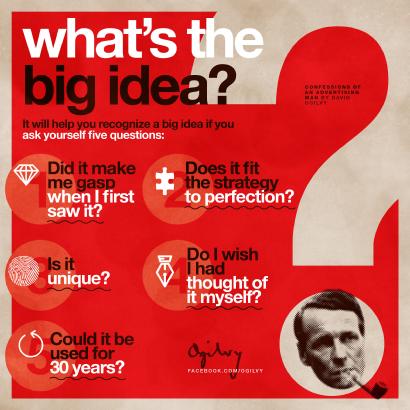
David Ogilvy, one of the icons of modern advertising, had five points on What’s a Big Idea?
- Did it make me gasp when I first saw it?
- Did it fit the strategy to perfection?
- Is it unique?
- Did I wish I had thought of it myself?
- Could it be used for 30 years?
All very interesting, but they’re also subjective to Mr Ogilvy.
What makes a Big Idea a Big Idea?
Here are five other attributes that are a tad more objective. Use them at your discretion.
(Oh, by the way. I’ve never found one idea that has all five attributes. If you create one that has “several,” I’d say you were on to a good thing.)
A Big Idea should be …
New
No one has ever thought of that idea before, ever.
Unique
In your category or industry, no one has ever previously implemented that idea.
Bold
The idea’s been done before, but never in this way, nor at this level.
Compelling
The idea may have been done before, but even so, it’s still thoroughly engaging. People love to interact with it, see it, participate in it, revel in it.
Simple
Less a fifth attribute than one I’ve learnt is indeed true of every Big Idea I’ve studied.
If your idea can’t be explained in one sentence, it’s too complex. And not a single person on this planet likes complexity.
But, before I go, let me tell you one thing I do know about a Big Idea.
You’ll never know it’s a Big Idea until it’s all over.
I hate to burst your bubble after reading all of this, but the best definition of a Big Idea is impossible.
Why? Because you never know something will be a Big Idea until after it’s been launched, implemented and finished. Only then, in context, will you have the full scope between the idea’s original objective and the campaign’s ultimate outcome.
As Will Rogers said: One must wait until evening to see how splendid the day has been. In other words, only history will tell us whether something has worked or not.
So, as I often do, the best advice I can give people is to follow what Nana Eklund often told me:
Do the best job you can. And afterward, pray.
Any other qualifiers you’d add to What’s a Big Idea? Please add your thoughts and comments below.



2 Comments
“You’ll never know it’s a Big Idea until it’s all over.”
That’s the tricky part because you never know which idea has the potential to become something big, you tend to judge your own ideas far too harshly and constantly second-guess them.
It’s incredibly difficult to decide whether an idea truly has the foundation to become something great when you’re the one who came up with it.
What a wonderful comment, and I absolutely 100% agree.
That said (as if you need to remember this) one of the most important things you can do for yourself, as a creator of any type, is to set criteria for yourself outside of the creative endeavour. HOW will you know if an idea is GOOD or not? Without objective criteria, you’ll use emotional criteria, which are fine, but they are also not constant. Emotions change, minute by minute or day by day.
Also, don’t use “I can sell this idea” as a criteria. It’s bad criteria because YOU are the point of the sentence when you’re really looking for external endorsement. Instead, try “My fans/my buyers would like his idea.” This of course begs the question: what do you fans want (not “what would they buy?”) When you know who your audience is, you also know what they want, how much they’ll “stretch” with you, etc.
And finally, just because you came up with something now doesn’t mean it’s good now … sometimes you need to separate yourself from the ideas for a bit.