
To bring structure to your thoughts when delivering important messages to an important audience, you should consider these basic four elements of a communications ‘argument’.
By ‘argument,’ I don’t mean a fight but a rational, factual outlining of your objective for the other person to understand your perspective. It’s similar to how a trial lawyer might outline their argument to a jury.
Here’s a definition of ‘argument’ from the Cambridge Dictionary:
A reason (or reasons) why you support or oppose an idea or suggestion, or the process of explaining these reasons.
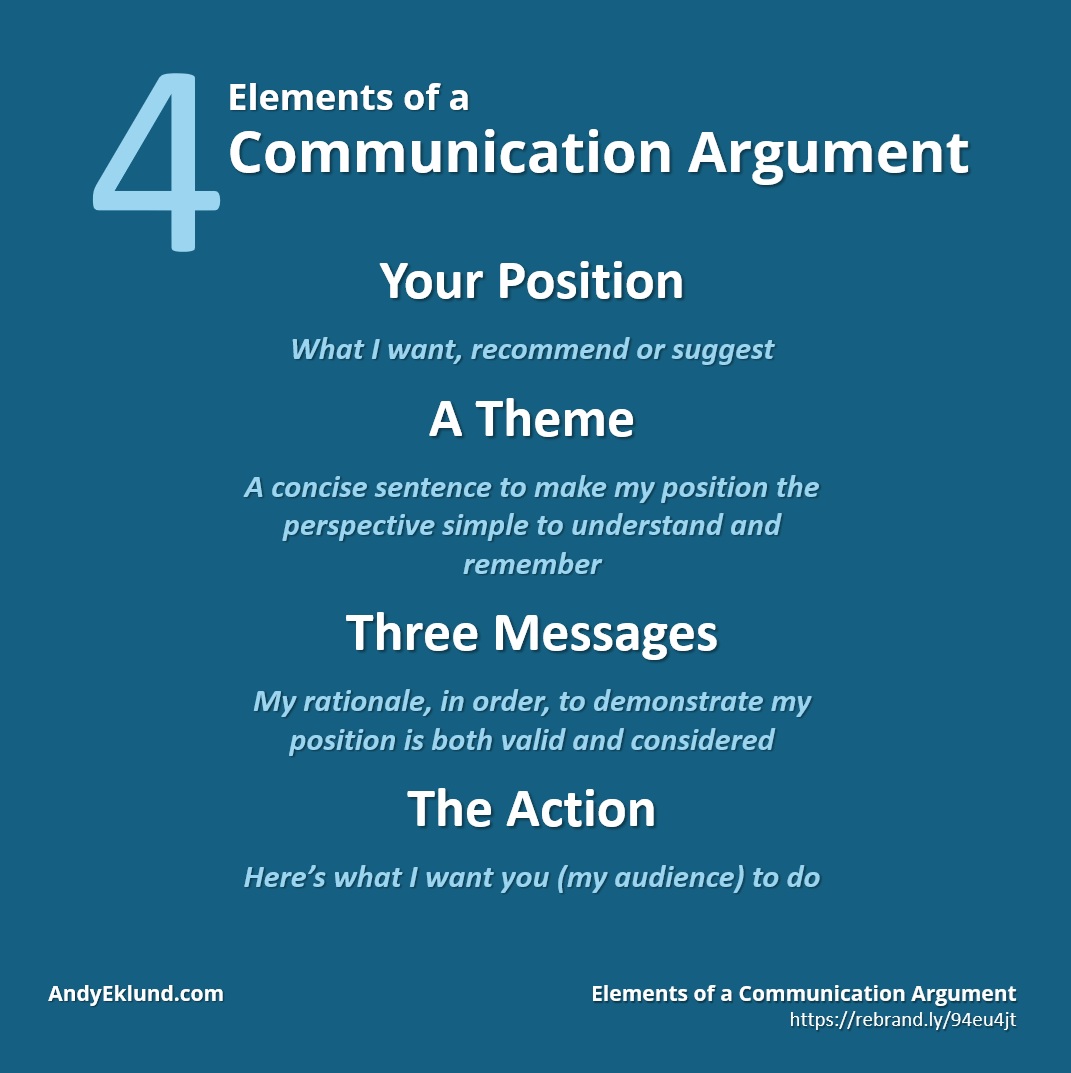
In business, most communication involves these core elements of your argument or discussion. Your …
1. Position “Here’s what I want, recommend or suggest”
2. Theme “Here’s a concise sentence to make my position (or my perspective of the position) simple to understand and remember”
3. Messages “My rationale, in order, to demonstrate my position is both valid and considered”
4. Action “Here’s what I want you (my audience) to do”
Position
Your position is the goal, or your perspective of the goal. What’s the point or purpose of your communications? Why are you talking?
Here is a detailed list of synonyms what your position may be. (It’s not definitive. Feel free to suggest others in the Comments section below.)
- Decision
- Goal
- Hypothesis
- Idea
- Judgment
- Objective
- Opinion
- Opportunity
- Plan of action
- POV
- Problem
- Purpose
- Recommendation
- Strategy
- Suggestion
- Tactic
- Theory
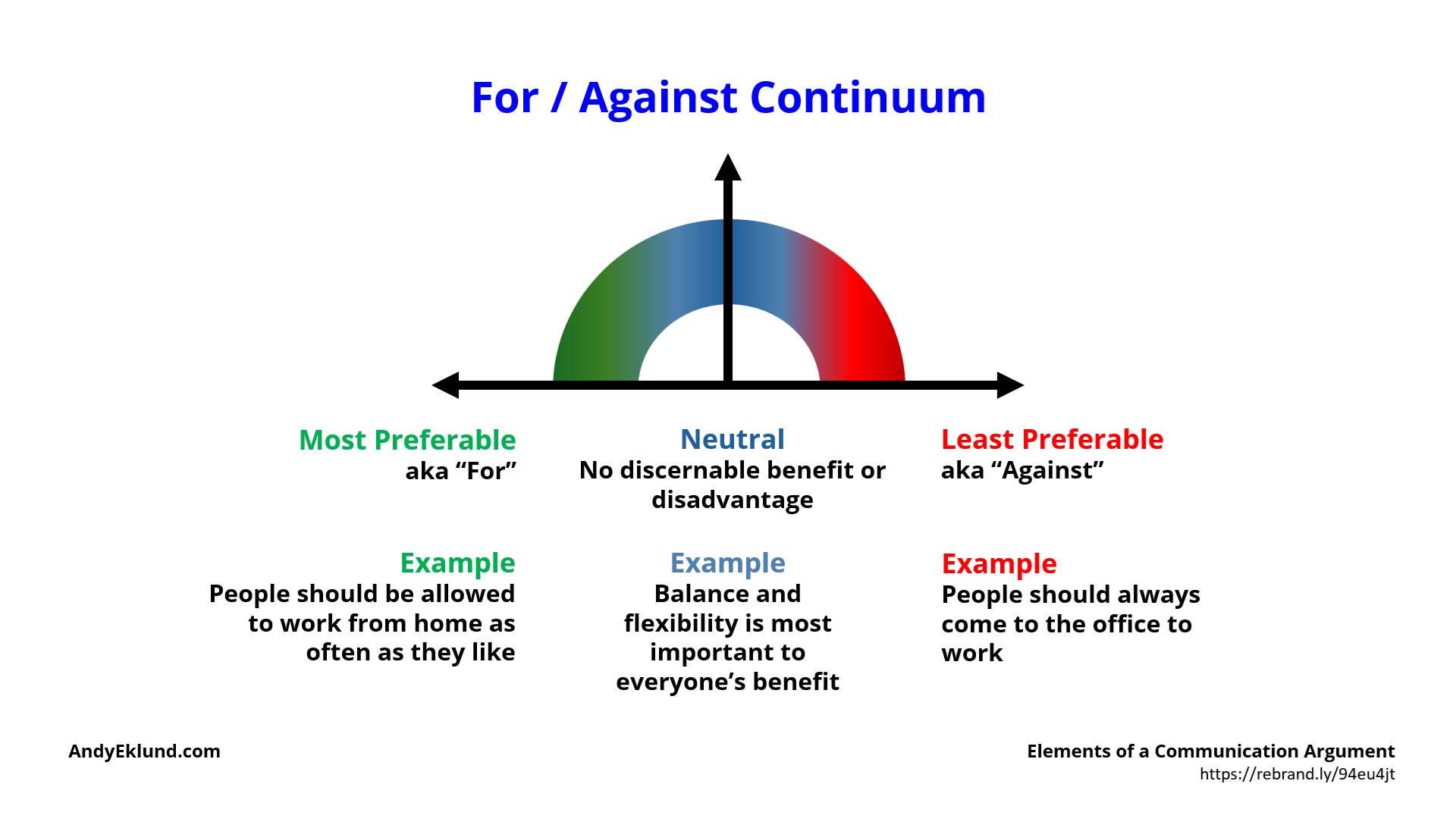
Your Position: For or Against?
Sometimes the position may also be the opinion you choose on a specific topic, typically in three loose areas:
- For – the most preferable option or situation
- Neutral – no discernible benefit or disadvantage
- Against – the least preferable option or situation
Theme
The theme is the entire argument in one concise sentence that often appears in the communications, again and again. Sometimes the theme is direct and explicit, such as an internal “rallying cry” of a change program. Other times, it’s subtle and inferred in the communications, but made explicit at the end of the messages, like the moral of an Aesop story.
Other times, it’s as simple as the subject line of your email or title of a presentation.
In short: it’s a quick summary – preferably in one easily understood phrase – of your argument overall.
Not every communication needs a ‘theme,’ so don’t try to force one when it’s not necessary.
Messages
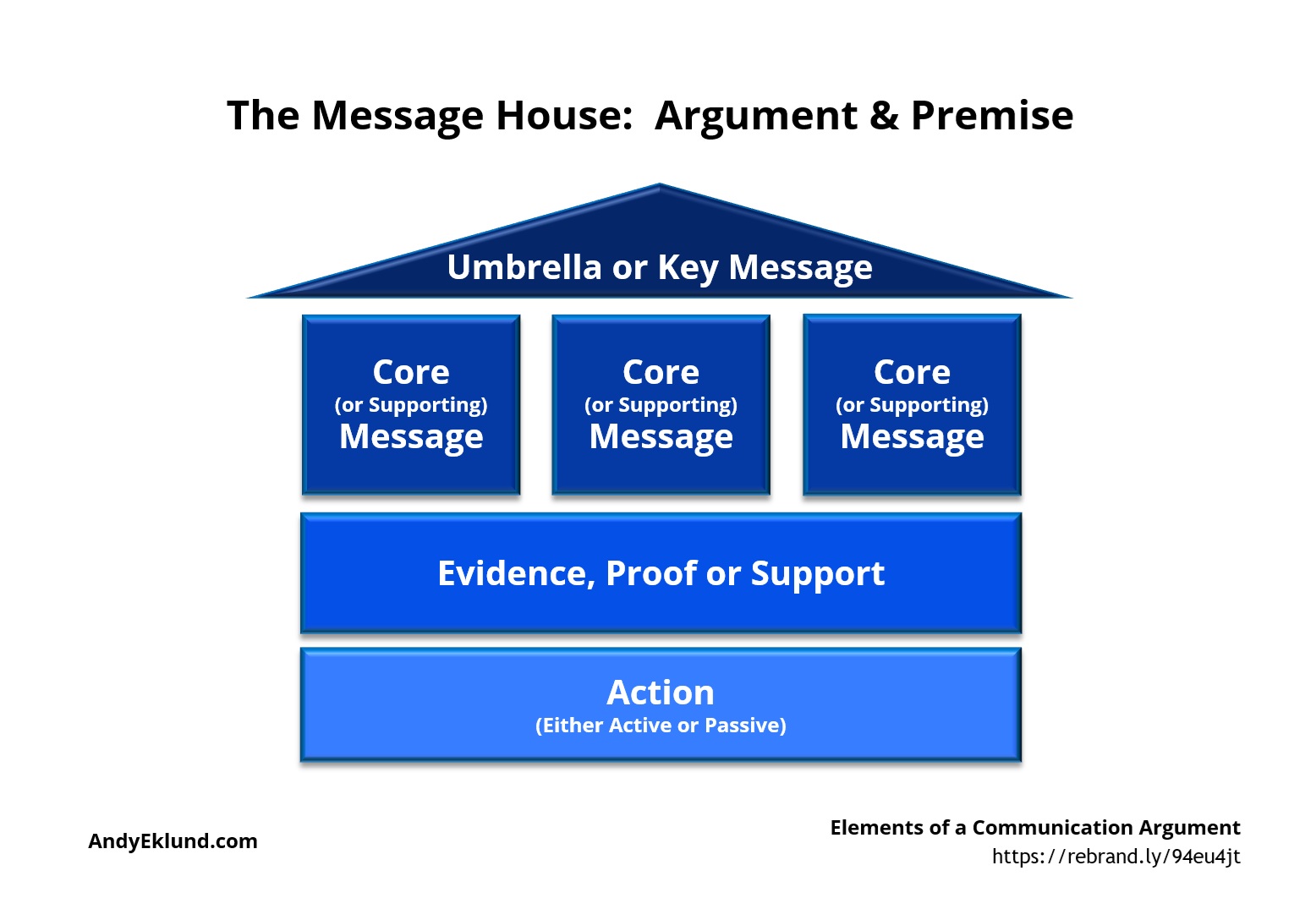
This is the “meat” of your argument. The literal words you’ve chosen to define your:
- Goal
- Supporting messages
- Rationale
- Evidence, proof and support, and
- Action
The Message House system is by far the best tool to help organise and structure your messages.
Download this 6-page document with details about the four levels.
Action
Finally, what do you want the audience to do or consider when you’re finished. There are two types:
“Do” suggests active action.
The audience takes specific steps which can be measured to ensure you reach your objective or position. Here are some examples of common active action.
- Agree that …
- Allow us to …
- Approve we …
- Buy this …
- Do this …
- Do nothing (for now) …
- Endorse this …
- Submit a …
- Participate in …
“Consider” suggests passive action.
The audience takes specific steps which are largely unseen. It’s difficult if not impossible to accurately measure passive action.
- Consider this …
- Keep this …
- Know this …
- Read this …
- Remember this …
- Think this …
Remember, your audience will never work harder than you. They aren’t going to decipher your vagueness. Be clear and explicit.
Most of all, choose the right action in case a senior person asks you if your communications was effective so you can adequately measure your program.
Here’s an article in the same vein: Making an Argument.
For more about “active vs passion action” in context of both business and communications objectives, try this post: The Most Common Business and Communications Objectives.
Any other thoughts or comments to add when you create your ‘argument’ in communications? Please feel free to share your opinions in the box below.


No comment yet, add your voice below!