
Most people in business would agree that critical thinking skills are one of the most valuable resources an employee could have as it helps the person to:
- Gather proper information
- Analyse the data for relevance and application
- Challenge assumptions, and
- Evaluate evidence based on its usefulness …
in order to make logical, reasonable and objective decisions to improve the business, if not help the organisation reach its goals..
Better critical thinking skills also help anyone – not just in business – to solve problems better (longer, more efficient), to improve communications, and make better decisions.
But what makes a critical thinker? What are these skills?
Forgive me, but this always comes up, so let me add it here up-front. What’s the difference between critical thinking and analytical thinking? >> Go here.
What is Critical Thinking?
There are many fancy definitions around, but I like this one for its simplicity. And, it also helps explain why it’s called critical thinking in the first place.
Critical thinking is the skill of critiquing – hence, the name.
In more simple terms, you compare any thing against any other thing, often by putting it into context.
Thing: a fact, statistic, an opinion, a picture, a graph, a piece of art, a point of view, etc.
Context: to provide background information, circumstances or a more broad perspective so both/either can be better understood for what they are.
And, you critique in two ways.
You compare – to identify how things are alike, equal or similar.
You contrast – to focus on how and why they are different, and what those differences mean (again, often in context).
By doing so, you are best able to extract insights to make better solutions or decisions.
What Skills Make a Critical Thinker?
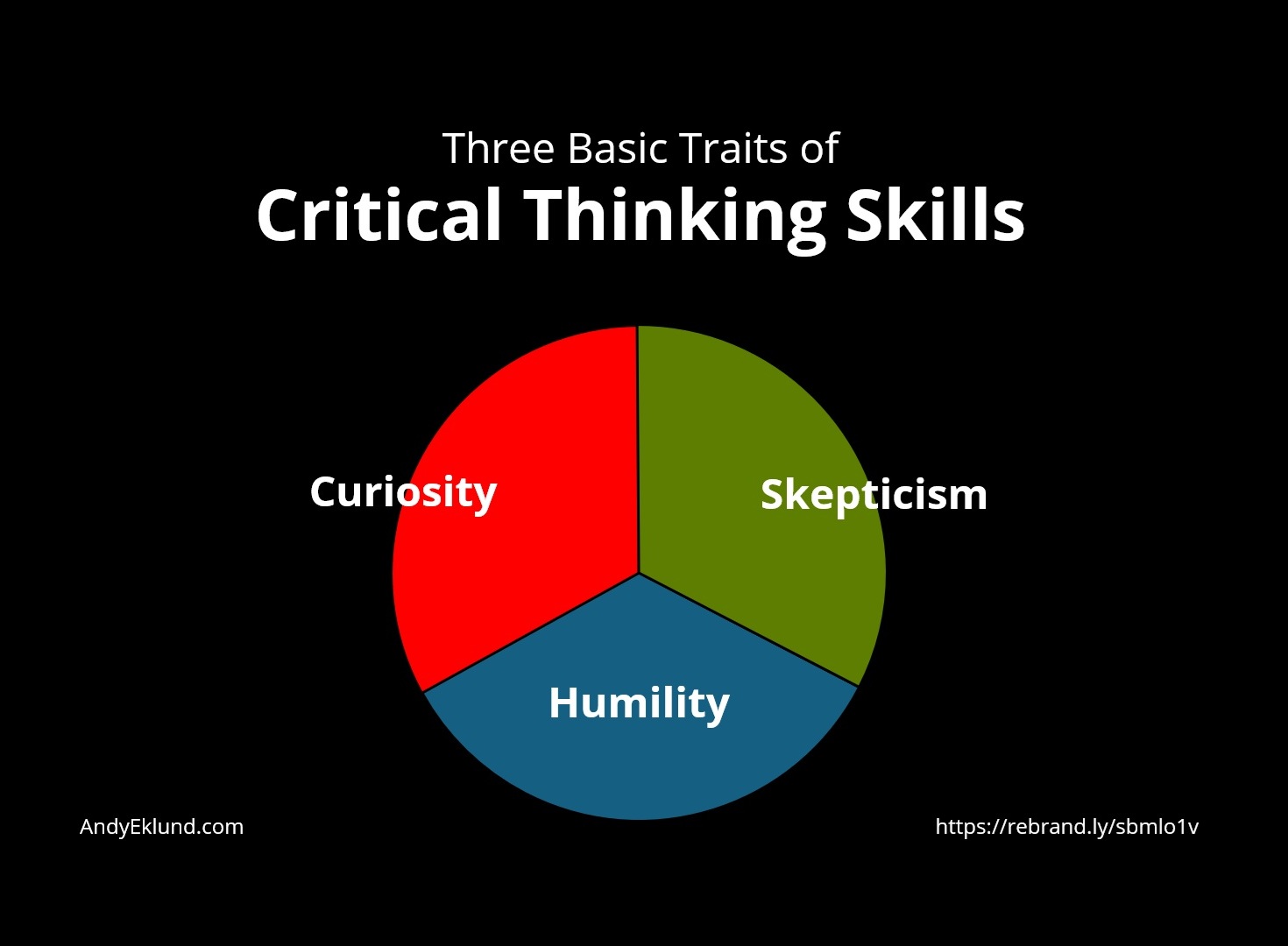
You could probably write out a long list of specific skills. But frankly, here are the top three. If you have these, you’re well on your way to being a critical thinker.
And, as I tell my daughter, these are the three of the most important aspects in life, not just critical thinking.
You need:
Curiosity
The desire to learn more information and seek evidence as well as being open to new ideas.
Scepticism
Taving a healthy questioning attitude about new information that you are exposed to and not blindly believing everything everyone tells you.
Humility
The ability to admit that your opinions and ideas are wrong when faced with new convincing evidence that states otherwise.
A Cultivated Critical Thinker
Here is a few excellent lists on critical thinking skills from The Foundation for Critical Thinking. Their website is absolutely a treasure of excellent information, so please visit for more information.
A well cultivated critical thinker:
- Raises vital questions and problems, formulating them clearly and precisely
- Gathers and assesses relevant information, using abstract ideas to interpret it effectively
- Comes to well-reasoned conclusions and solutions, testing them against relevant criteria and standards
- Thinks with an open mind using alternative systems of thought, recognising and assessing, as need be, their assumptions, implications, and practical consequences, and
- Communicates effectively with others in figuring out solutions to complex problems.
Characteristics of a Critical Thinker
Also from the Foundation for Critical Thinking:
- Inquisitiveness about a wide range of issues
- Desire to become and remain well-informed
- Alertness to opportunities to use critical thinking
- Trust in the processes of reasoned inquiry
- Self-confidence in own abilities to reason
- Open-mindedness towards divergent world views
- Flexibility in considering alternatives and opinions
- Understanding of the opinions of other people
- Fair-mindedness in appraising reasoning
- Honesty in facing own biases, prejudices, stereotypes, etc.
- Discretion in suspending, making or altering judgments
- Willingness to reconsider and revise views where necessary.
Capability Framework for Critical Thinking and Problem Solving
And finally, some nicely detailed skills, knowledge, and behaviours of critical thinking:
- Research and analyse information, identify interrelationships and make recommendations based on relevant evidence
- Anticipate, identify and address issues and potential problems and select the most effective solutions from a range of options
- Participate in and contribute to team/unit initiatives to resolve common issues or barriers to effectiveness
- Identify and share business process improvements to enhance effectiveness
- Undertake objective, critical analysis to draw accurate conclusions that recognise and manage contextual issues
- Work through issues, weigh up alternatives and identify the most effective solutions
- Take account of the wider business context when considering options to resolve issues
- Explore a range of possibilities and creative alternatives to contribute to systems, process and business improvements
- Implement systems and processes that underpin high quality research and analysis
- Engage in critical analysis of a wide range of complex information and formulate effective responses to issues
- Identify and evaluate organisation-wide implications when considering proposed solutions to issues
- Apply lateral thinking and develop innovative solutions that have long standing, organisation-wide impact
- Ensure effective governance systems are in place to guarantee quality analysis, research and problem solving
Two Additional Websites for More Information
Here are two additional websites for more information on critical thinking skills.
A PD download from the University of Houston’s Law Center: Critical Thinking: What It Is and Why it Counts by Peter A. Facione.
From Monash University in Melbourne, Australia: What is Critical Thinking?
Any other thoughts or additional skills to add to Critical Thinking?
Please add your thoughts and comments below.


No comment yet, add your voice below!